Kala Nag
The Jungle BookKala Nag, whose name means Black Snake, is one of the most experienced working elephants in the Government of India and the central animal figure in the story of Little Toomai. Nearly seventy years old, he embodies extraordinary service, controlled violence, inherited human trust, and an independent allegiance to the life of elephants. His decisive significance lies in the contrast between what people use him for and what he knows: he is a disciplined instrument in military and elephant-catching work, yet he remains connected to a hidden elephant world beyond human command.
Identity and Background
Kala Nag had served the Government of India in every way an elephant could serve it for forty-seven years. Because he was already twenty when he was caught, this service made him nearly seventy years old. His history reaches back before the Afghan War of 1842, when he was still young and not yet fully strong. He had pushed a gun from deep mud with a leather pad on his forehead, carried twelve hundred pounds of tents on marches in Upper India, crossed the sea aboard a ship, and transported a mortar through a strange rocky country far from India. He had also witnessed the death of Emperor Theodore at Magdala and returned from that campaign with the reputation of having earned an Abyssinian War medal.
His service was not confined to military transport. After seeing elephants die from cold, epilepsy, starvation, and sunstroke at Ali Musjid, Kala Nag was sent thousands of miles south to haul and stack teak in the timberyards at Moulmein. There he nearly killed an insubordinate young elephant that was shirking its share of work. Later, the Government transferred him from timber hauling to the capture of wild elephants in the Garo hills, where specially trained elephants helped human crews drive, restrain, and break in their wild kindred.
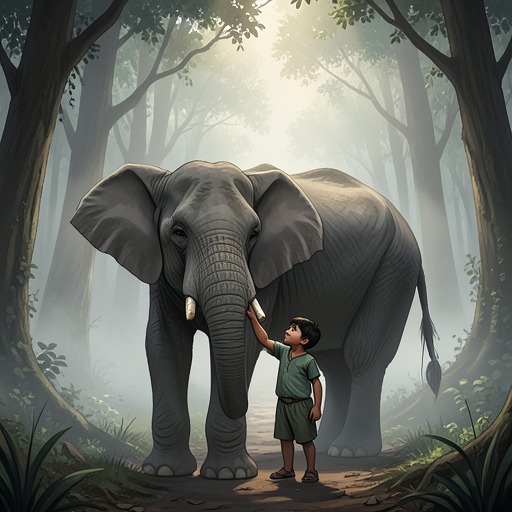
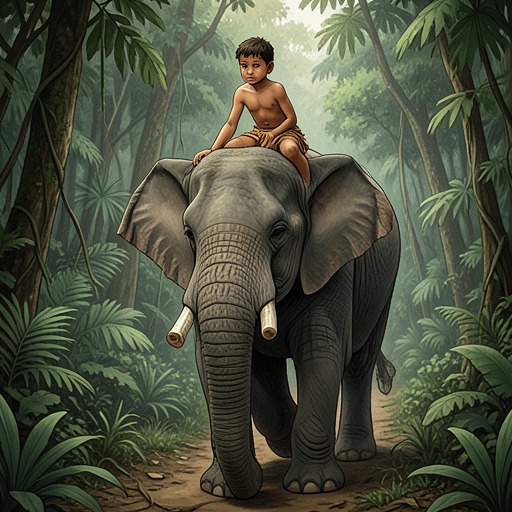
Kala Nag's physical appearance makes his age and power visible. He stands ten feet at the shoulder. His tusks have been cut down to five feet and bound at the ends with copper bands to prevent splitting, but the shortened tusks remain more effective in his hands, or rather in his head and trunk, than full tusks would be in an untrained elephant. The name Black Snake is therefore more than a label: it joins his dark, formidable presence to the quick, controlled force of a striking animal.
Work, Combat, and Discipline
During an elephant drive, dozens of wild elephants could be forced into a final stockade, where a huge drop gate of lashed tree trunks closed behind them. At the word of command, Kala Nag entered the confusion of trumpeting animals, often at night when torchlight made distances hard to judge. He selected the largest and wildest tusker, hammered and hustled it into submission, and held it quiet while men riding other elephants roped the smaller animals. His strength is therefore inseparable from his discipline: he does not merely overpower; he identifies the dangerous target and performs the task assigned to him amid collective panic.
He also possesses a formidable knowledge of fighting outside the work of elephant capture. More than once he faced a wounded tiger. When the animal sprang, Kala Nag curled his soft trunk out of danger and struck the tiger sideways in mid-air with a rapid, sickle-like movement of his head. He then knocked it down and knelt upon it until its life left it. The scene reduces a terrifying predator to a striped body that Kala Nag can pull by the tail, establishing the old elephant as a combatant who understands both timing and restraint.
Yet his obedience is not simple submission. Big Toomai, his driver, claims that Kala Nag fears no one except him, while the family has fed and groomed the elephant through three generations. Little Toomai insists that Kala Nag fears him as well, and proves the intimacy of their relationship by walking up, insulting him playfully, and making him lift his feet one after another. The elephant obeys the boy's shrill commands because their relationship began before Little Toomai could walk: the child played with his trunk, led him to water, and grew up beneath his shadow. Kala Nag's obedience is thus presented as a learned bond with a family, not merely the mechanical effect of the goad.
Relationship with Little Toomai
Little Toomai is expected to inherit his father's place on Kala Nag's neck and eventually handle the heavy iron ankus, already polished smooth by his father, grandfather, and great-grandfather. The succession links the elephant to a human lineage extending across four generations. Little Toomai imagines a future in which a rich ruler might buy Kala Nag for his size and manners, dress him in gold, place a jeweled howdah on his back, and lead him at the head of royal processions. Even in that fantasy, however, the boy prefers the elephant's present work in the jungle to ceremonial display.
The relationship becomes decisive when the camp settles after the capture of wild elephants. A distant wild-elephant call causes every elephant in the lines to stir. Big Toomai removes Kala Nag's leg chain to secure another elephant and leaves only a loop of grass around Kala Nag's leg, telling him to remember that he is tied. Kala Nag does not answer in his usual way. He stands facing the moonlit Garo hills, his head raised and ears spread, as if listening to a call older and more compelling than the camp's commands.
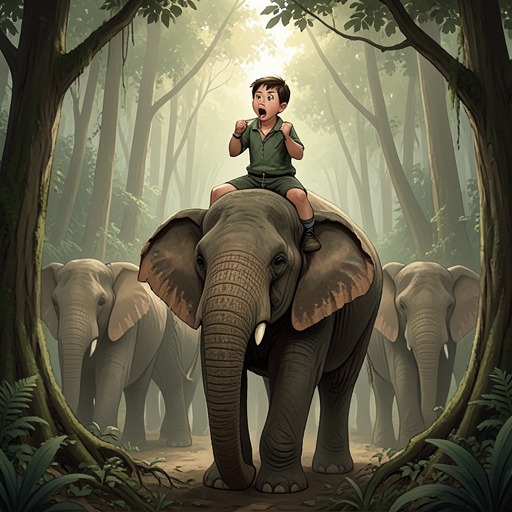
When the grass string snaps, Kala Nag leaves slowly and silently. Little Toomai follows barefoot, asking to be taken along. Kala Nag turns back, lowers his trunk, lifts the boy onto his neck, and enters the forest. This action reveals both affection and choice. The elephant is capable of leaving without the child, but returns for him; Little Toomai is not dragged into the adventure but accepted as a companion. Their intimacy allows the boy to cross a boundary that no ordinary human observer could cross.
The Night Dance of the Elephants
Kala Nag carries Little Toomai uphill through the Garo forest with almost complete silence. Grass brushes his sides, pepper vines scrape his back, and bamboo creaks against his shoulder, but the elephant himself moves as though the forest were smoke. From a ridge, Little Toomai sees the treetops, mist over the river, bats, porcupines, and a digging hog-bear, while the forest appears awake and crowded around him. Kala Nag is not simply transporting a passenger; he is guiding him into an animate realm whose signs the boy can only partly interpret.
In the clearing, the elephants trumpet and then begin to stamp together. Their feet fall with the regularity of trip-hammers, producing a booming rhythm that shakes the ground. The movement lasts for what seems to Little Toomai to be two hours. The elephants surge forward briefly, crushing green growth, then return to the hard-earth stamping. By dawn the sound stops as abruptly as if light itself had issued an order.
Only Kala Nag, Pudmini, and the elephant with rope-galls remain visible. The clearing has changed: trees stand within it, while the grass and undergrowth have been rolled back and beaten into hard earth. Little Toomai understands that the elephants have made space through their collective trampling. Kala Nag has therefore brought him to witness an organized act whose meaning is not supplied by human instruction. The boy sees what no person has seen before: the elephants' night dance, performed alone in the heart of the hills.
Narrative Significance
Kala Nag's story places several systems of order beside one another. The jungle teachings given by Baloo to Mowgli include rules for moving through forests, addressing wild bees, warning water-snakes, and requesting permission to hunt beyond one's own grounds. The elephant camp likewise depends on commands, ropes, chains, drivers, and inherited technical knowledge. But the night dance reveals another order, one that humans cannot command and that the camp's equipment cannot explain.
This contrast is especially important because Kala Nag is repeatedly treated as property, labor, and military technology. His tusks are cut and bound, his body carries tents and mortars, and his strength is deployed against wild elephants. At the same time, the narrative gives him memory, judgment, courage, selective obedience, family attachment, and access to a communal life of his own species. The animal is not reduced to either a domestic servant or an untamed force. He moves between human institutions and elephant society, competent in both but possessed by neither.
The story also makes witnessing an ethical privilege. Little Toomai's access to the dance depends on trust between child and elephant, while the adults at the camp remain excluded. Kala Nag's decision to return for the boy transforms the child from a mahout's son into the sole human witness of a hidden ceremony. His significance therefore rests not only on age or strength, but on mediation: through Kala Nag, the human world briefly enters an elephant world without mastering it.